
monthly macro monitor
key trends for the agency mbs investor
APRIL 2026
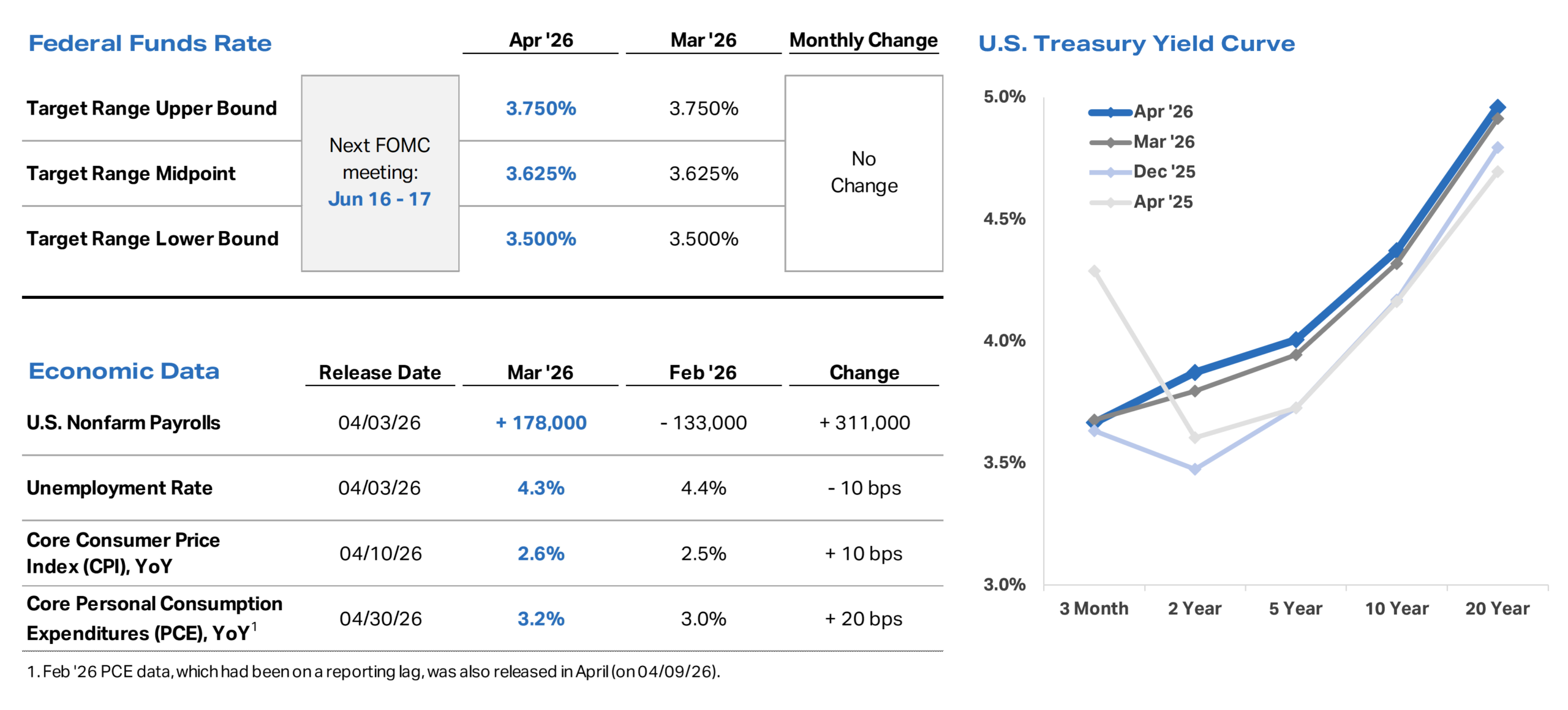
- Energy Crisis and Volatile Geopolitical Backdrop: Global energy prices remained significantly elevated in April amid the ongoing conflict in the Middle East and the continued closure of the Strait of Hormuz. Following significant volatility in March as the conflict escalated, the announcement of a temporary ceasefire in early April, which has since been extended, calmed financial markets. Despite the market’s reversion to a risk-on sentiment in April, the global geopolitical backdrop remains fragile and volatile.
- Employment: Key employment measures released in April were stronger than expected. U.S. nonfarm payrolls (NFP) were materially above estimates and prior month levels, and the unemployment rate declined slightly month-over-month. Previously reported NFP data for January and February were revised modestly lower by 7,000 jobs in aggregate.
- Inflation: Key inflation measures released in April increased month-over-month, which was generally consistent with expectations amid the surge in global energy prices. Not surprisingly, inflationary pressures – and their implications for the Fed’s expected neutral rate level – were a primary focus during the Fed’s April 29th press conference. PCE data releases returned to the normal schedule in April with both February and March data released during the month, finally ‘catching up’ from delays caused by the government shutdown from October to mid-November.
- Federal Reserve and Monetary Policy: As expected, the FOMC maintained the 3.50-3.75% target range for the federal funds rate at its April meeting, highlighting global energy prices as a key contributor to elevated inflation measures. In his final press conference as Fed Chair, Powell acknowledged that “inflation is kind of misbehaving” and characterized the current stance of monetary policy as being “at the high end of neutral or perhaps mildly restrictive,” which “is the right place to be” and positions the Fed “in a very good place…to wait and see” as the Committee continues to assess the impacts of energy shocks and tariffs filtering through the U.S. economy. Read our April Fed Report for more details.
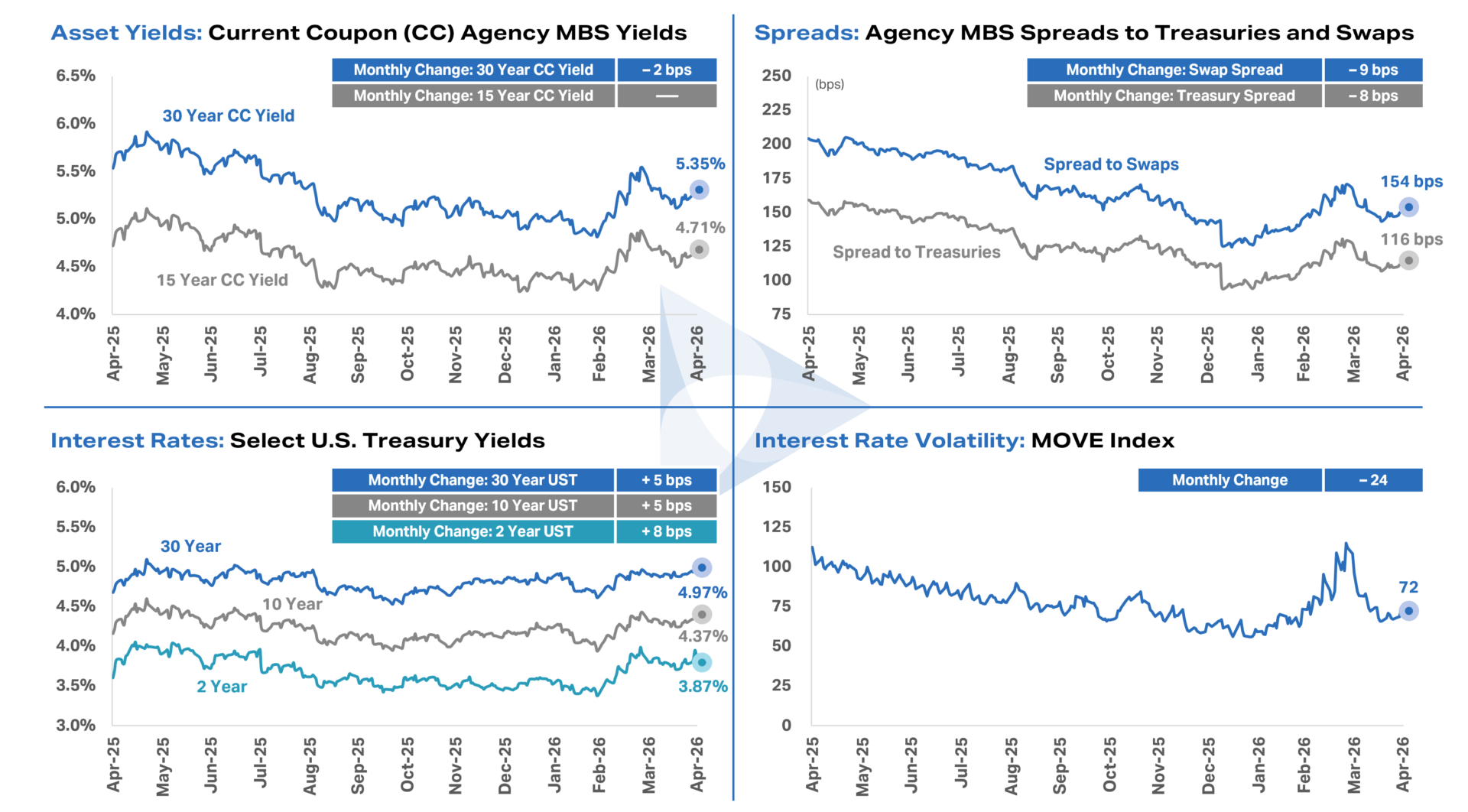
- Interest Rates and Agency MBS Spreads: Increased inflationary pressures caused near-term rate cut expectations to decline, driving higher interest rates across the curve. Against the backdrop of calmer financial markets, however, interest rate volatility declined month-over-month, and Agency MBS spreads to benchmark rates tightened.
Key Economic Data and Yield Curve Trends
Key Rate and Spread trends
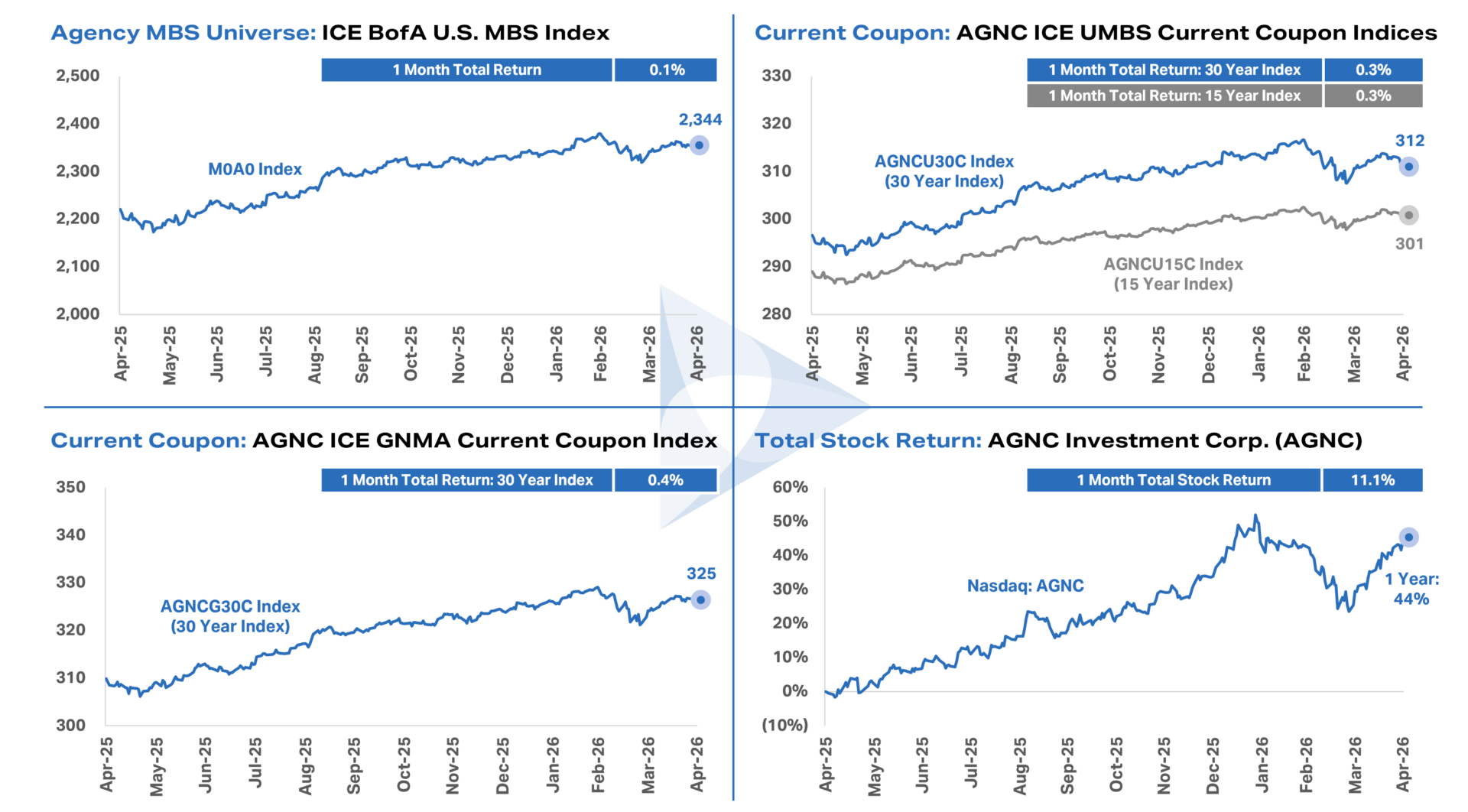
mortgage performance
Important Notices and Disclosures
Data and commentary, including thoughts, opinions, and outlook of AGNC Investment Corp. (“AGNC”) management, are provided for informational purposes only and should not be construed as investment advice.
Federal funds rate data last updated April 30, 2026. Source: Federal Reserve.
Economic data last updated April 30, 2026. Core CPI and Core PCE exclude food and energy. Source: Bureau of Labor Statistics and Bureau of Economic Analysis.
U.S. Treasury yield curve reflects month-end Treasury yields for each tenor and month shown. Source: Bloomberg.
Agency MBS spread to U.S. Treasuries and Agency MBS spread to swaps reflect the 30-year current coupon Agency MBS yield spread to a 50/50 average of 5- and 10-year U.S. Treasury yields and a 50/50 average of 5- and 10-year SOFR OIS swaps, respectively. MOVE Index reflects the ICE BofA Move Index. Each chart is shown over the trailing 12 months ended April 30, 2026, and each monthly change (rounded to the nearest whole number) reflects the difference between April 2026 month-end data and March 2026 month-end data. Source: Bloomberg.
The ICE BofA U.S. Mortgage Backed Securities Index (M0A0) is shown over the trailing 12 months ended April 30, 2026, and the total return is measured over the one month ended April 30, 2026. Source: Bloomberg.
The AGNC ICE UMBS 30-Year Current Coupon Index (AGNCU30C) and the AGNC ICE UMBS 15-Year Current Coupon Index (AGNCU15C) track the performance of 30-year and 15-year, respectively, fixed rate residential mortgage pass-through securities issued under the Uniform Mortgage-Backed Security (UMBS) program guaranteed by Fannie Mae and Freddie Mac. The AGNC ICE GNMA 30-Year Current Coupon Index (AGNCG30C) tracks the performance of U.S. dollar denominated 30-year fixed rate residential mortgage pass-through securities publicly issued by Ginnie Mae (GNMA) in the U.S. domestic market. Each chart is shown over the trailing 12 months ended April 30, 2026, and each total return is measured over the one month ended April 30, 2026. Source: Bloomberg.
ICE Data Indices, LLC (“ICE Data”) is the Administrator and the calculation agent for the AGNC ICE UMBS 30-Year Current Coupon Index, the AGNC ICE UMBS 15-Year Current Coupon Index, and the AGNC ICE GNMA 30-Year Current Coupon Index (collectively, the “Indices”). Additional information regarding the Indices is available at indices.ice.com. You may not download, use, share, disclose, transmit, publish, distribute, disseminate, scrape, or commercialize the Indices data contained herein. ICE DATA AND ITS THIRD PARTY SUPPLIERS MAKE NO EXPRESS OR IMPLIED WARRANTIES, AND HEREBY EXPRESSLY DISCLAIM ALL WARRANTIES OF MERCHANTABILITY OR FITNESS FOR A PARTICULAR PURPOSE WITH RESPECT TO THE INDICES, INDICES VALUES OR ANY DATA INCLUDED THEREIN AS WELL AS WITH RESPECT TO THE CALCULATION AND DISSEMINATION OF SUCH INDICES. IN NO EVENT SHALL ICE DATA AND ITS THIRD PARTY SUPPLIERS HAVE ANY LIABILITY FOR ANY SPECIAL, PUNITIVE, DIRECT, INDIRECT, OR CONSEQUENTIAL DAMAGES (INCLUDING LOST PROFITS), EVEN IF NOTIFIED OF THE POSSIBILITY OF SUCH DAMAGES.
The indices cited herein are provided for information purposes only. To the extent the index provides a general investment strategy, it does not take into account any specific needs or financial circumstances of any person, entity or group of persons or entities and should not be considered investment advice or a recommendation to buy or sell securities. Past performance of the index is not indicative of future performance. Actual ongoing or future performance will vary, perhaps materially, from the performance provided herein. The performance of each index does not include fees or costs of any financial instrument that references the index. Index levels for periods before the index’s live date represent hypothetical data determined by retroactive application of a back-tested model, itself designed with the benefit of hindsight. Index information, data and values included herein are provided on an “as is where is” basis and are subject to the disclaimers and other important disclosures included in ICE’s Bond Index Methodologies available here or on ICE’s website. AGNC makes no representation or warranty, express or implied, with respect to the indices, any index value or data included therein, including any warranty of merchantability or fitness for a particular purpose, and any and all representations and warranties are hereby disclaimed. For additional important information, disclosures, pool cohort construction, and index methodologies, please refer to the following links: AGNCU30C, AGNCU15C, and AGNCG30C.
AGNC total stock return is measured over the trailing one and 12 months ended April 30, 2026; it includes price appreciation and dividend reinvestment, and dividends are assumed to be reinvested at the closing price of the security on the ex-dividend date. Past performance is not indicative of future results. Source: Bloomberg.
Investment in AGNC involves risks and uncertainties that may cause future performance to vary from historical results or any forward-looking commentary provided. Please refer to our annual and quarterly reports on file with the SEC and available on our website or at www.sec.gov for more information about AGNC, including material risks, other factors that may affect future performance, and notices regarding forward-looking statements. AGNC disclaims any obligation to update or revise any forward-looking commentary. Stockholders and other interested parties may sign up to receive AGNC’s news, perspectives, and other types of email alerts by clicking the Subscribe link.